Your complete guide to
Cashless Arcade Systems for FEC Operations
Take a deep dive into the hardware, guest experiences, and operational strategy behind going cashless, with key analyses and benchmarks from industry leaders.

Table of Contents
Table of Contents

So your arcade still runs on coins and tokens?
Every year, more of your guests arrive at your venue without a wallet. Their payment methods, loyalty cards, and even their car keys now live on their phones. When a family walks up to your counter and the first thing you hand them is a cup of tokens, you have already created friction before they have played a single game.
This shift in consumer behaviour does not only impact payments. As covered in our guide to starting an FEC business, we now operate in the experience economy, where guests pay a premium for seamless, staged experiences rather than goods and services. A coin jam, a queue at the change machine, or a lost paper ticket is not a minor inconvenience—it’s a poor experience that will most likely show up in your reviews, your repeat visit rate, and your revenue per guest.
This guide covers everything you need to evaluate, implement, and profit from a cashless arcade system: the right technology, the hardware decisions, the guest experience gains, the operational payoff, and the business case for making the switch.
What is a cashless arcade system?
Compared to traditional coin-op FECs, a cashless arcade system replaces coins, tokens, and paper tickets with digital payment media, typically RFID game cards, wearables, or a mobile wallet, that guests tap on arcade game card readers to play. The system connects every game, kiosk, and point of sale to central management software, giving operators real-time control over pricing, revenue, and guest data.
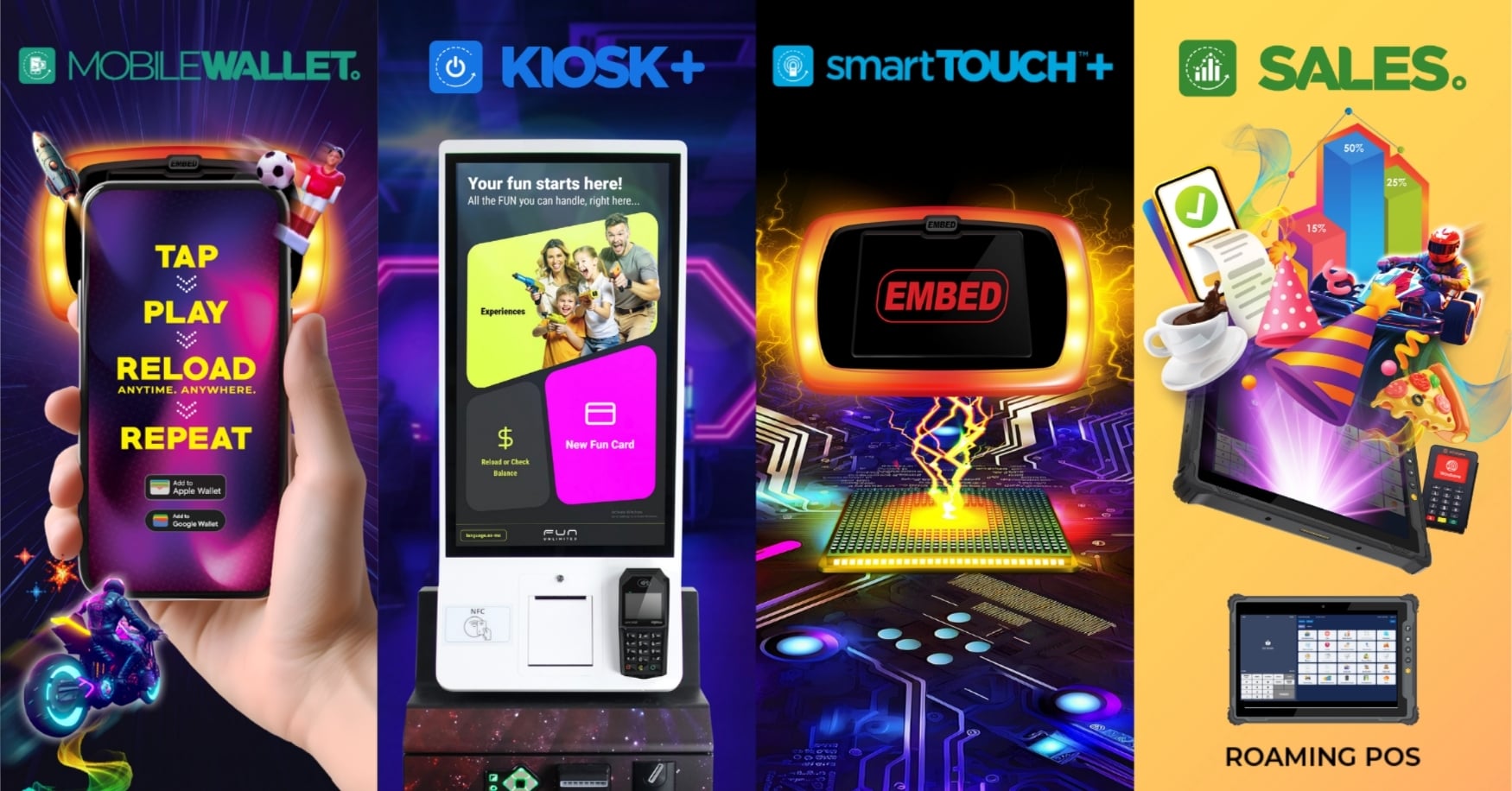
A complete cashless arcade system typically includes:
- Payment media - Game cards, RFID wristbands or wearables, and virtual cards in Apple Wallet or Google Wallet
- Card readers - Tap or swipe contactless game card readers installed on every game and attraction
- Point of sale integration - A unified POS that sells, reloads, and tracks play credit alongside food, beverage, and retail
- Self-service kiosks - For card purchase, reload, and balance checks without staff involvement
- Bookings platform – To process reservations and waivers for events, attractions, and experiences
- Management software - The reporting, pricing, and games management layer that turns every guest interaction and touchpoint into data
LET’S TALK ABOUT
Arcade Payment and Guest Technology
Tap-to-play replaces inserting a coin with a contactless transaction. A guest taps their game card, wristband, or in-mobile virtual game card on a reader mounted to the game. The reader verifies the balance against the central system, deducts the game price, and activates the game, all in under a second.
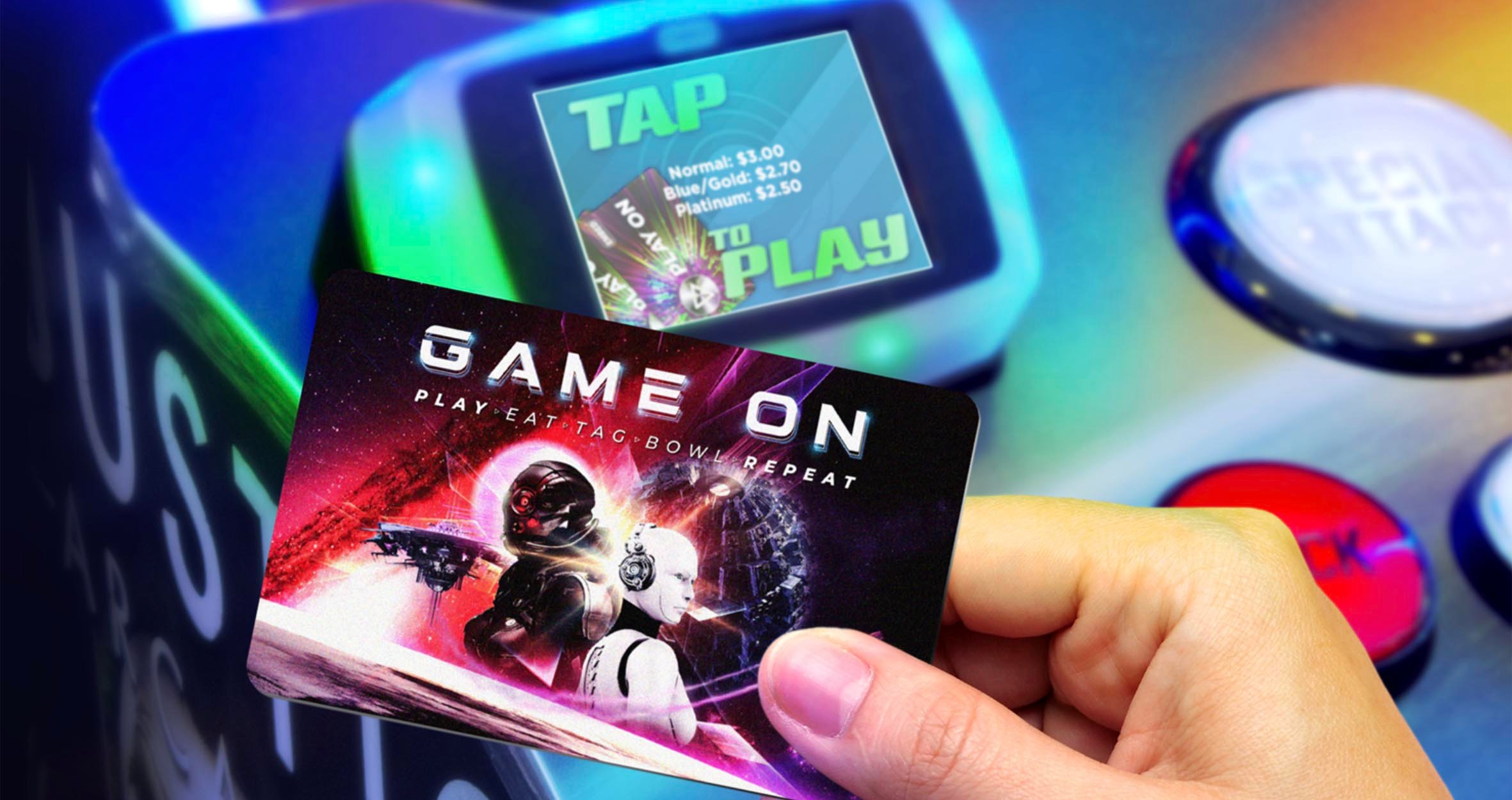
These technologies work together to make this seamless transaction happen:
- Radio Frequency Identification (RFID) - This powers the cards and wearables themselves. Each carries a unique identifier linked to a guest account and balance.
- Near Field Communication (NFC) – This is the short-range standard that lets phones and contactless bank cards communicate with readers—the same technology behind Apple Pay and Google Pay.
- Central management software – At the backend, this ties every reader to one source of truth, so a card loaded at the front counter works instantly on the game floor, logging every tap.
As an operator, you don’t want to focus on just the speed at the game. Every tap becomes a data point: which games are played, at what times, by which guest segments, and at what price. Coin-ops cannot give you any of that actionable data.
Aside from the lack of critical guest and game data, running an FEC on coins puts you at high risk for downtimes—and an offline game earns nothing. Every minute counts, and with manual operations, game failures are either noticed by a staff member or reported by a guest. Until then, no income is generated from that machine.
Cashless arcade systems eliminate token mechanism jams. No coins also mean no token hoppers running empty; no ticket printers running out mid-session. Contactless readers have no moving parts at the payment point, which is why operators consistently report higher game uptime after converting:
After switching to a cashless arcade system, Palomar Amusements reduced 14 hours of labour a week—equivalent to a few shifts of a part-time high school staff hired to refill tickets, attend to coin jams, and game errors. And with a system in place, inevitable downtimes due to game equipment failure don’t hurt revenue; there are system backups in place that keep games running and income-generating amidst damage.
NFC arcade payment systems: how does the money move?
NFC is the bridge between your closed-loop game card system and the open-loop payment world your guests already live in. At FECs with a modern cashless arcade system setup, a guest can:
-
Add a virtual game card to their Apple Wallet or Google Wallet before they arrive
-
Load value onto that card from their phone, at a kiosk, or at the counter
-
Tap their phone directly on a game card reader to play
That pre-arrival reload is a commercially important part. When guests can reload value before entering your venue, their first touchpoint inside is spent playing, not queuing. Metric results from Embed’s Mobile Wallet guest usage showed that 60% of reloads happen before guests arrive at the venue. Pre-payment is a guaranteed profit for you, whether guests choose to use those credits on the day of reload or for another time.
Security is handled the same way it is in contactless banking: tokenisation and encryption mean the reader never stores usable card data. For payment processing, ensure your provider is PCI compliant end to end.
Choose your hardware: arcade card reader and POS buying guide
Hardware comprises key components guests and staff touch hundreds of times a day—your game card readers, kiosks, and POS at your counter should be carefully evaluated to match operational cashless reality, not just spec sheets.
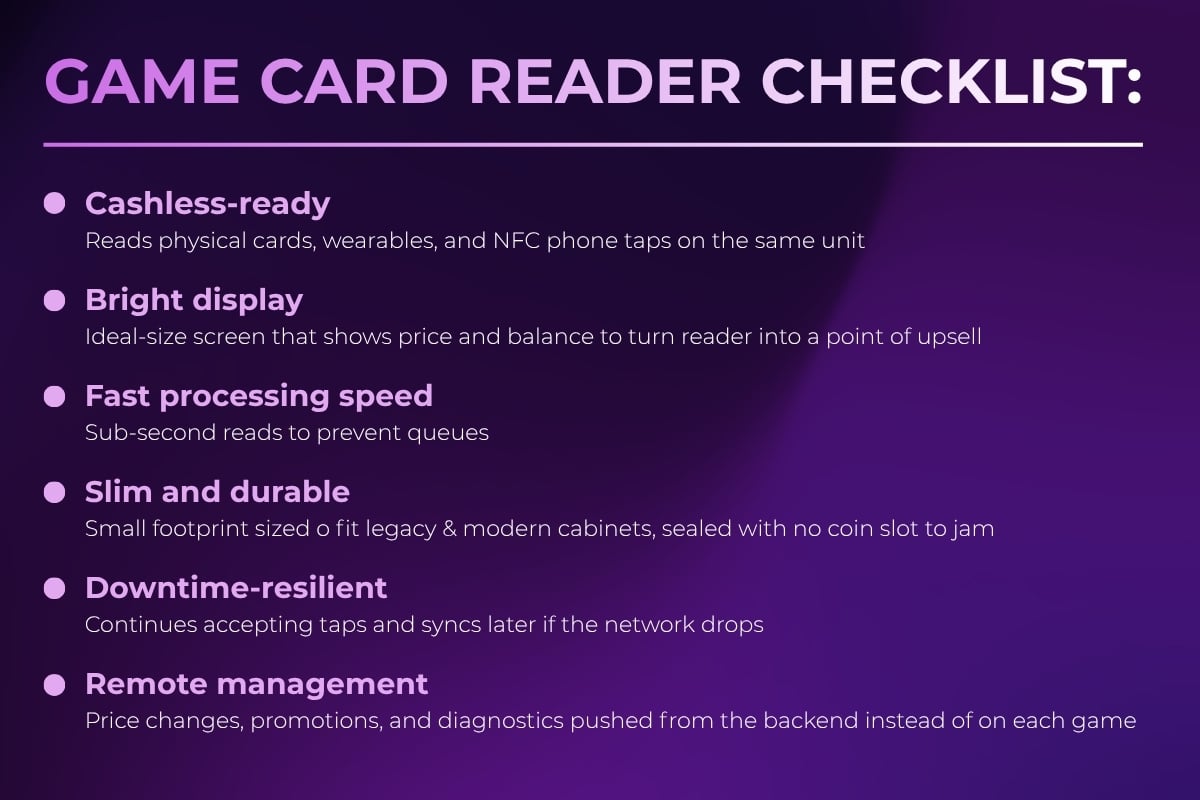
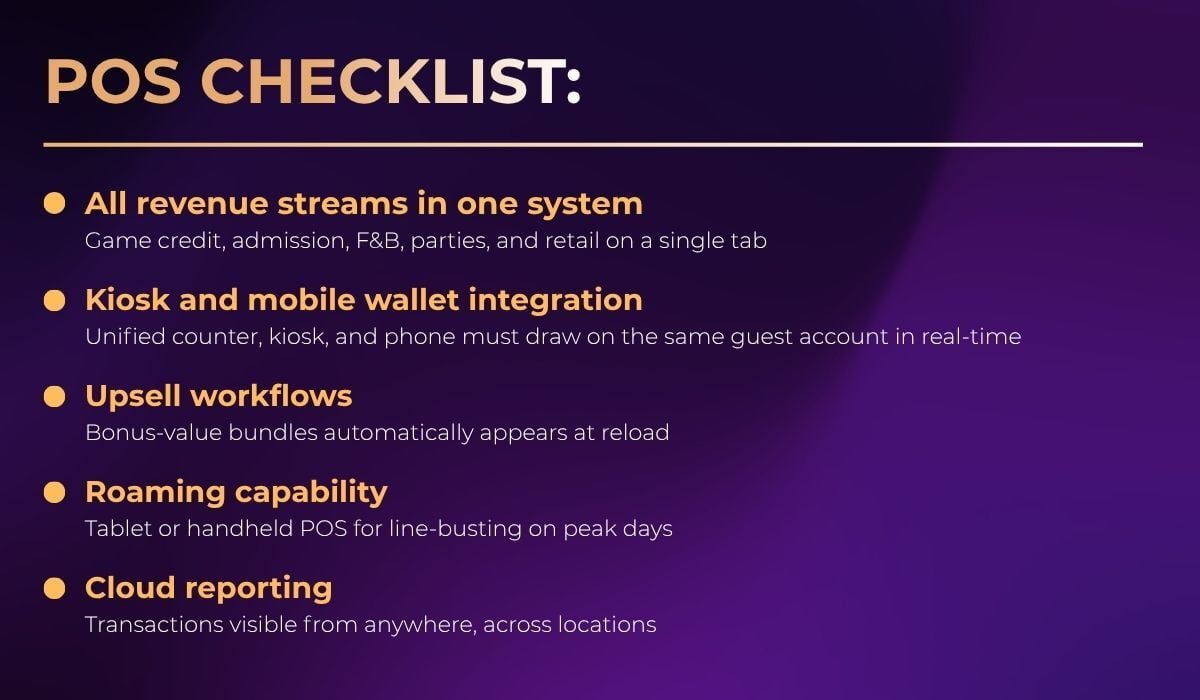
An invisible essential to both checklists is integration. A reader from one vendor, a POS from another, and reporting from a third means three support contracts and no single source of truth. If these touchpoints do not talk to each other, it will be a backend reconciliation problem every cycle. For a successful cashless transition, you’ll need connected hardware and software solutions that “talk” to each other, easily manageable from one central system.
Integrations are also necessary to grow the arcade cashless system’s compatibility with other operational software as your business expands and your offerings widen. When picking the right system for your FEC, make sure to talk about developer integrations and partnerships compatible with your options.
Custom game cards and RFID arcade wristbands: your take-home branding

The game card is the only piece of your brand a guest can bring home. A game card in their wallet is a physical reminder to return. A branded RFID wristband on a child's wrist at school is advertising. Other than putting your FEC top-of-mind, custom FEC media help you achieve:
- Loyalty or member tiers - Standard game cards for walk-ins, premium game cards or wearables for members, and special themed media for party or events packages
- New revenue stream - Limited edition designs engage guests with collectability
- Security and ease of use – Parents can assign wearables for younger guests—nothing to drop, lose, or feed into a game incorrectly. Plus, parents can also load value onto a wristband they control from their phones.
- Attraction-specific entry - Essential if your venue includes water play or outdoor attractions
Because balances live in the system rather than on the media, a lost game card is a service moment instead of a loss. Staff can simply freeze the old card and issue a new one with the balance intact—something you cannot do with lost tokens but can manage seamlessly with FEC media or mobile wallets.
Guest Experience & Revenue Growth
How do you improve every visit to influence higher profitability?
Guest flow is the physical journey through your venue: entry, purchase, play, reload, redeem, and exit. On the other hand, guest experience is how that journey feels. To make both seamless, operators should treat these as one connected project. Every queue in the flow is a dent in the experience, and every dent in the experience shows up as lower spend.
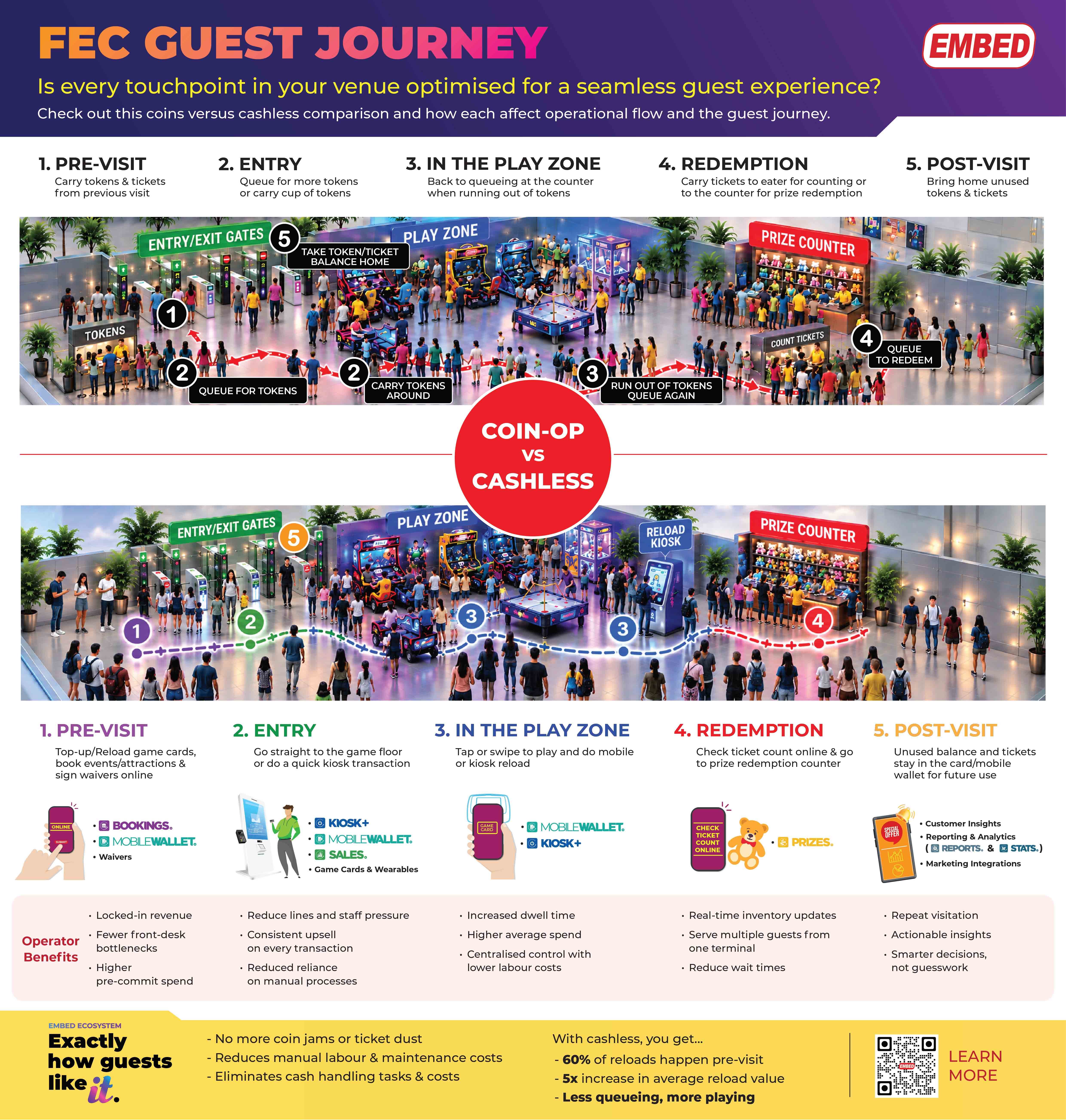
The revenue mechanics behind this are simple. Guests who are playing are spending; guests who are queuing may be deciding to leave. Reducing friction converts idle minutes into billable experiences. It also changes spending psychology: reloading a card in preset bundles produces a higher average transaction than feeding coins one game at a time, and bonus-value bundles (ex. pay 20, get 25 in credit) reward larger loads while guaranteeing the full amount is committed to your venue.
Cashless also removes old-model challenges like disputes over eaten coins, children in tears over lost tickets, parents doing mental math in a queue. Staff who spent their shifts counting tickets and clearing jams are redeployed to hosting, upselling, and party service, which is work that actually grows revenue.
Arcade self-service kiosk solutions: a guide to choosing the best for your game room floor
Self-service is how you improve guest flow without scaling payroll. Labour remains the biggest cost pressure for FECs. IAAPA's 2025 Entertainment Center Benchmark Report found that payroll accounted for 29% of total operating expenses, more than any other expense category. Every transaction a self-service kiosk handles represents savings from labour costs.
When evaluating self-service kiosk solutions, look for:
- Full transaction coverage – For new card purchase, reload, balance check, ticket balance, and registration on one unit
- Upsell configuration – To design and build your own bonus bundles and promotions presented on screen at the crucial decision moment
- Multiple payment acceptance modes – Should have contactless, chip, and mobile payments as standard
- Accessibility and language options - Easily usable by children and by every family in your market
- Small footprint and remote health monitoring – Every square foot of floor space is revenue space, and an offline kiosk should alert your team before a guest finds it
- Bonus value tiers - Visibly better value at higher load amounts, nudging the guest one tier up
- Time-based promotions - Off-peak bonus credit that shifts demand into your quiet hours, protecting peak margin
- Membership conversion – By the third or fourth reload, the kiosk becomes the ideal place to present a membership offer. IAAPA's 2025 Entertainment Center Benchmark shows that 32% of passholders visit more than 10 times per year, compared with only 6% to 15% of non-passholders, depending on region. The reload screen is where you can convert occasional guests into higher-frequency visitors.
Placement matters as much as capability. Entryway kiosks catch new arrivals; kiosks deep on the game floor catch the mid-session reload, which is the transaction most likely to be abandoned if it requires walking back to a counter queue.
Understanding game card reload kiosk and its role in upselling
The reload is the most valuable transaction in your venue because it is a pure repeat purchase from a guest already inside. A reload kiosk exists to make that purchase instantly and to make it larger. Your choice of reload kiosk should run these upsell mechanics:
Every kiosk transaction is also logged to the guest account, feeding the behavioural data that the next topic turns into operating decisions.
Arcade Operations & Automation
With a cashless system in place, how will you run your venue then?
Cloud arcade management: run the venue from anywhere

Cashless systems generate full return only when the management layer is cloud-based. On-premises servers tie your data, and you, to the back office. A cloud platform means:
- Easy access - Pricing, reports, and game status from a laptop or phone, on or off-site
- Real-time sync – The counter, kiosks, card readers, and reports all draw on one live database
- Resilience - Local operations continue and sync later if connectivity drops, and you are not maintaining server hardware in a storeroom
- Continuous updates - Features and security patches arrive without an engineer visit. Always stay updated with the latest release notes from your chosen solutions providers.
- Lower IT overhead - No server refresh cycle, no local backup regime
- One guest account for any of your locations: Cards, balances, tickets, and memberships work across all your sites, turning each location into a driver for the others
- Unified games database: Consistent naming and pricing so cross-site reports are easy to reconcile from game to game
- Consolidated reporting: Every site's revenue, game performance, and labour visually represented on one dashboard, with site-level drill down
- Central pricing control: A promotion configured once and pushed everywhere, or targeted to one site's non-peak time
- Standardised operations: New locations onboard onto a single proven configuration instead of reinventing the process for each venue
If you’re a single-location operator, you might think twice about setting up a cloud-based management system. The kind of business visibility it can give you is exactly what you need to scale—removing the technical burden of running infrastructure. If you’re already planning for a next location, this solution is non-negotiable, which leads us to the next point.
Scaling to a multi-location arcade management
The operational gap between one venue and two is wider than most operators expect. Separate systems per site mean separate card networks, separate reports, duplicated admin, and guests whose card from your first venue is worthless at your second. A centralised cashless system closes this gap this way:
The strategic payoff is that your data compounds. Two sites on one platform tell you which games, price points, and promotions travel, which is exactly the kind of data you need before opening a third.
FEC business intelligence and reporting
Every tap or interaction on a cashless system is a row of data. Business intelligence is how those rows become decisions. The difference between a report and intelligence is whether it changes what you do next. Here is a brief overview of the core reporting capabilities of a modern FEC platform:
|
CAPABILITIES |
DATA |
ACTIONABLE INSIGHTS |
|
Game performance reporting |
Which games earn their floor space, by hour and by day? |
Relocate, reprice, or retire underperformers. Purchase more of what works. |
|
Guest activity and segmentation |
Who visits, how often, and what do they spend on? |
Targeted promotions, membership offers, party marketing |
|
Revenue stream analysis |
How do games, F&B, parties, and retail each contribute? |
Floor space allocation and bundle design |
|
Peak and off-peak analysis |
When is the venue full, and when is it empty? |
Staffing curves, dynamic pricing, off-peak promotions |
|
Manpower analysis |
Where do labour hours go against revenue by daypart? |
Rosters built on demand, not habit |
|
Inventory and redemption reporting |
What is moving at the prize counter, and what is shrinking? |
Prize purchasing and shrinkage control |
|
Automated report delivery |
Which reports/data should I regularly look at? |
Daily number delivery in your inbox before you ask |
Cost, ROI, and Making the Switch
Family Entertainment Center Business Plan Sample
Coins to Cashless Migration To-Do List
- Audit the floor.
- Every game—its coin mech, earnings history, and cabling.
- Retire games the data says are done.
- Choose the platform.
- Use the hardware and POS checklists above, plus weight integration
- Plan the cutover.
- Run a short dual period where the counter sells game cards while legacy tokens are honoured for redemption only. Set a firm token sunset date and publicise it.
- Install and test-off peak.
- Test every game with live game cards before guests do.
- Train your team.
- Staff who can explain the card system confidently are drive higher usage of your arcade cashless system. Script the answer to "what happened to tokens?" and "how do refunds work?"
- Incentivise your launch.
- A founding bonus offer (extra credit on first loads) converts your regulars and seeds the guest database from day one.
- Retire cash handling.
- As card adoption climbs, pivot to reduce float, close the charge machine, and reallocate the labour
Communicate the guest benefit instead of the technology. Prepare your marketing to drive adoption of your new cashless system, and don’t forget to make guests aware upfront of what they are to expect: no more coin queues, non-expiring balances, and tickets that count themselves.
Eliminating cash handling friction
The cost of cash is paid in labour and leakage, and most operators miss it. This is what cash actually costs you each week:
- Counting, reconciling, and preparing float at open and close
- Emptying coin hoppers game by game
- Cash-in-transit or staff time for banking runs
- Discrepancies, miscounts, and shrinkage
- Change machine maintenance and float capital sitting idle in machines
- Manager hours spent investigating till variances
Every one of those lines shrinks toward zero as cash leaves the building. Reconciliation becomes a report instead of a time-consuming task. Shrinkage disappears when the cash drawer does. Ultimately, the venue’s security changes: no cash on site means less risk for both guests and operator.
There is a guest-side benefit too. More staff freed from counting and clearing jams means more guest hosting and interactions on the floor.
Calculating your cashless arcade system ROI
The return on a cashless system comes from four stacked effects. You can model each against your own numbers:
- Higher spend per guest - Bonus reload tiers, pre-arrival loading, and frictionless play raise average committed spend versus coin-op
- Lower operating cost - Cash handling labour, coin mech maintenance, and reconciliation hours are removed
- Higher game uptime - No coin jams mean more earning minutes per game per day
- Breakage and float – Unspent card balances remain committed to your venue, and reload value is banked before it is played
To build the model in three steps, first, baseline your current revenue per guest, cash handling hours at loaded labour cost, and estimated downtime. Next, apply conservative improvement assumptions to each. Set the total against the five-year cost of ownership from the vendor comparison above. And lastly, run pessimistic, expected, and optimistic cases. If the pessimistic case still clears your hurdle rate, the decision is made.
INDUSTRY INSIDER RECOMMENDATION
When choosing your arcade cashless system, look for the one that’s backed by the world’s best tech partners like Apple, Amazon Web Services, and Google.
From the game reader to the report in your inbox, every component in this guide performs best as part of one connected system: fewer reconciliations, one guest database, and a single source of truth as you scale.
Ready to see what cashless looks like in your venue? Get to know how the Embed Ecosystem is exactly how you like your cashless operations to work.






.svg)
.svg)
.svg)
.svg)
.svg)