Your complete guide to
How to Start a Family Entertainment Center
Business
Take a deep dive into the ins and outs of starting a FEC business with key
analyses and insights from industry leaders.

Table of Contents
Table of Contents

So you want to start a Family Entertainment Center business?
Among the many products and services businesses can offer these days, customer experience is the most important consideration and key to your success. You need business systems that enable optimal guest experience because when the customer thrives, your business thrives.
It’s no longer good enough to offer goods and services and call it a day. The four stages of economic progress can be easily understood in the evolution of the humble birthday cake. During the agrarian economy, mothers made cakes from scratch using low-cost farm commodities. In the goods-based economy, moms started paying to buy premixed cake ingredients (from a box).
Eventually, during the emergence of the service economy, parents ordered cakes from bakeries, which cost about 10x more than the premixed goods, but included the type of icing and cake decoration that mothers could not easily do at home. Enter the experience economy, where time-pressed, overworked parents spend $100 or more to book the entire birthday party at businesses that stage events – the cake is only offered as part of the party package.
The emerging experience economy, according to Harvard Business Review, is the next competitive battleground when it comes to catering to consumer demands.
A family entertainment center (FEC) is a venue where experiences such as games, attractions, food & beverage, and other activities that appeal to different age groups or families, as a whole, are offered.
Over the years, FECs have evolved to include a variety of attractions in their facilities as opposed to offering a single type of experience. According to the International Association of Amusement Parks and Attractions (IAAPA), these are some qualifiers for establishments to be considered as an FECs:
- Must be located within a commercial, tourist, or entertainment complex
- Typically do not charge an admission or entrance fee and may or may not be a gated property
- Games and attractions usually come as “pay-as-you-go”
- Often indoors but can be a combination of indoor and outdoor
- Offers a combination of at least three participatory activities (mentioned under Types of Family Entertainment Centers) as well as different types of food concession or service.
- Targets a specific age group or market (e.g children’s entertainment center, adults-only entertainment center)
Types of Family Entertainment Centers
FECs can range from the following indoor or outdoor amusement and attraction centers. Depending on what kind of experience you want to offer, here are family entertainment business ideas worth looking into.
- Family entertainment centers, arcades, and video games
- Bowling centers
- Cinemas
- Route operators
- Eatertainment
- Amusement parks & indoor parks
- Miniature golf course
- Water park
- Museum
- Zoo or aquarium
- Skating rink
- Go-Kart facility
- Indoor playground or soft play
- Laser tag arena
- Trampoline center
- Outdoor adventure facility
- Zipline or rope course
- Amusement or theme park
- Climbing walls
- Birthday party or events venue
- Social gaming
- Augmented reality (AR) or virtual reality (VR)
From venue to revenue
Starting a family entertainment center business includes various steps to success. Before taking that first step, it is imperative to understand how a venue will generate income for your intended business. Guest spending may consist of the following:
- Admission fees
- Food and beverages
- Tokens and other game currencies
- Retail
- Rentals
- Merch
The International Association for Amusement Parks and Attractions (IAAPA) statistics show that the frequency by which families visit FECs are dependent on memberships, passes, and casual visits. 40% of non-passholders visited once a year, 22% were at three to five times a year, and only 11% visited more than 10 times.
For passholders, 32% visited more than 10 times a year, showing how guest loyalty through memberships helps drive repeat visits significantly. With the 2025 family entertainment revenue mix, admissions account for 40%, 19% are for attractions and rides, followed by food and beverage offerings at 16%, birthday parties at 14%, and events, retail, and other accounts for the remainder.
In the same study, IAAPA notes that in 2024, the average FEC profit margin is between 10-20%, taking into consideration varying business models, scale, and costs.
Not only does this support how profitable the FEC business model is, but how effective an avenue it is for creating experiences that convert to revenue.
Steps to Starting a Family Entertainment Center Business
Identify Business Goal & Business Type
The ‘why’ of starting a business fuels the FEC operator. Aside from the money, what value are you expecting from starting an FEC business? Is it for the challenge of developing a thriving business? Is it to provide a venue to entertain families and friends for years? Is it to be at the center of fun while earning? The ‘why’ is usually tied to an individual’s passion and drive. This same passion, spirit, and energy will come across in everything you do and will inform every single business and operating decision you make, so it is imperative you are clear on ‘why’ you want to start an FEC and enter the industry of fun.
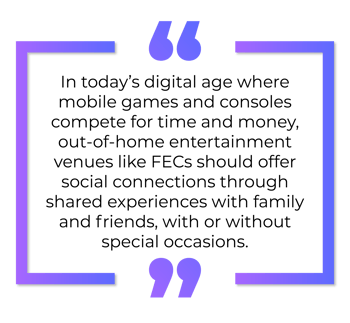
In today’s digital age where mobile games and consoles compete for time and money, out-of-home entertainment venues like FECs should offer social connections through shared experiences with family and friends, with or without special occasions.
The heart and goal of your business will be the main driver of loyal guests and customer returns. What makes your business unique? Guests can be entertained with the same offering someplace else, so it is the core (the ‘why’ you are in business) of a company that will inspire loyalty and returns.
Having a well-defined business goal will help you envision what type of customers you want to cater to, what type of venue will make these customers participate actively, and what type of experience you want them to enjoy.

The goal points the business in the right direction and leads it to sustained success. The birthday party circuit Discovery Zone had a rough couple of years because they failed to create a seamless guest experience—poorly maintained games, inconsistent event staging, and paying little attention to the ‘adults’ experience—they are the paying customers after all; they matter. It is imperative to set a business goal that is tied to a value system (why you’re in business and how you want to run your operation), stay true to it, and continuously evolve and innovate to achieve it.
According to the Harvard Business Review, before a company can charge admission or put a price on the experience it offers, it must design, market, and deliver the experience excellently.
There are a lot of profitable and sustainable family entertainment business ideas to choose from. You also have two choices: Will you start your own FEC from scratch? Will you purchase an existing FEC franchise?
Get inspired with these 8 Family Entertainment Center Business Ideas.
Determine Target Customers
Members of a family have different interests and are entertained for different reasons. Will your FEC focus on entertaining the family as a whole? Will it be for children only? Is it intended to be an amusement center for adults and teens?

Identifying your target audience will give you ideas on what your FEC needs when it comes to theme, hardware and equipment, activities to add to the venue, and so on.
By analysing the market population in the area where you intend to open the business, you can better determine the project’s profitability.
Market population analysis factors:
- Local drive-times – The average distance people will travel within an urban or suburban primary market area to an FEC is about 15 to 20 minutes maximum.
- Demographics (age and household) – Based on the findings on local drive-times and identified target areas therein, how many households and people are there? This information can be accessed at the local Chamber of Commerce, Community Business Office, or the city or state’s website.
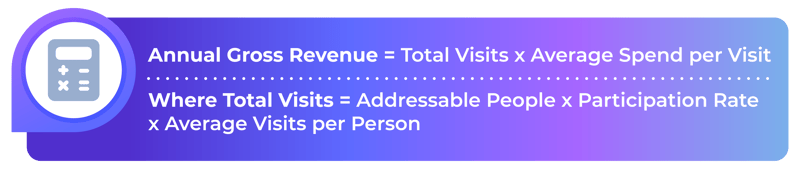
From this data set, compute how much that will equate to gross revenue. To have an initial sense of this, derive from the IAAPA statistics presented on visits:
Make a Feasibility Study
What goes into a market feasibility study?
- Site selection & characteristics
- Competitive analysis (direct and indirect competitors)
- Market area population analysis (with sources of foot traffic or tourist traffic)
- Project design, programming, and operation characteristics
- Attendance projections
- Per capita spending projections
- Revenue and expenses pro forma financial projections
- Revenue drivers (schools, commerce zones, residential zones, etc.)
- Design day capacity and size requirements
- Cost estimate
- Return-on-investment (ROI) projections
- Break-even and sensitivity analysis
Read more about how to do a market feasibility study for FECs.
You can also view: How to Choose the Right Location for Your FEC
Secure Capital & Funding
Create a Business Plan
Family Entertainment Center Business Plan Sample
Table of Contents
- Industry Overview
- Executive Summary
- Products & Services
- Mission & Vision Statements
- Job Roles & Responsibilities
- SWOT Analysis
- Market Analysis
- Target Market
- Sales & Marketing Strategy
- Sales Forecast
- Publicity & Advertising Strategy
- Pricing Strategy
- Startup Expenditure (Budget)
- Sustainability & Expansion Strategy
Whether it’s a business plan for arcade operation or a business plan for a children’s play centre, get started and download this FREE business plan template here.
Conceptualize & Design
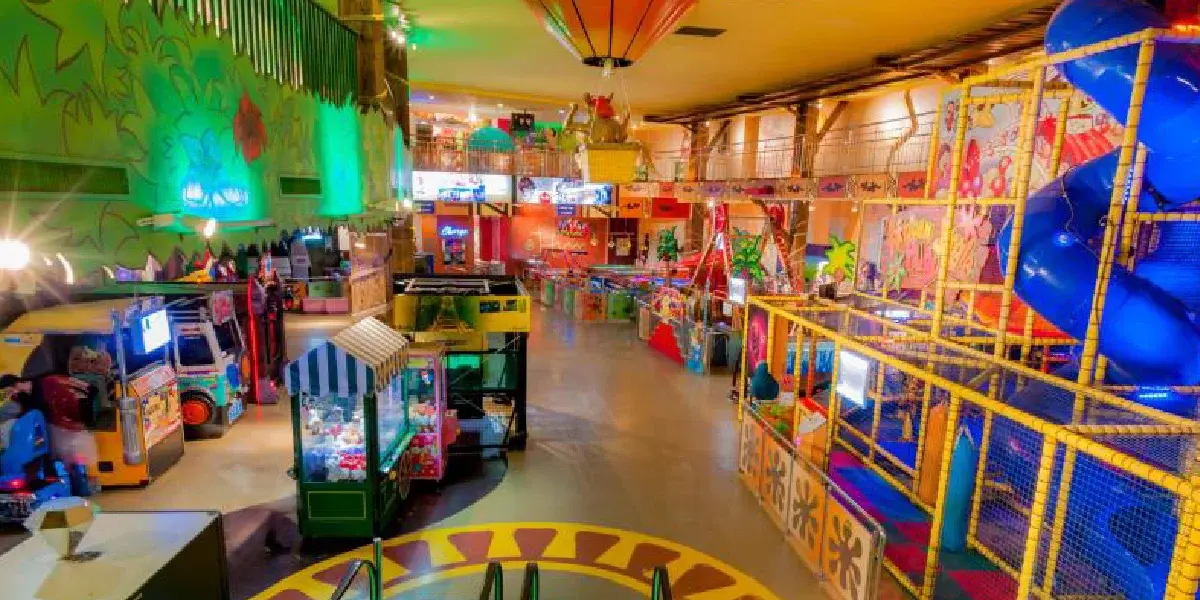
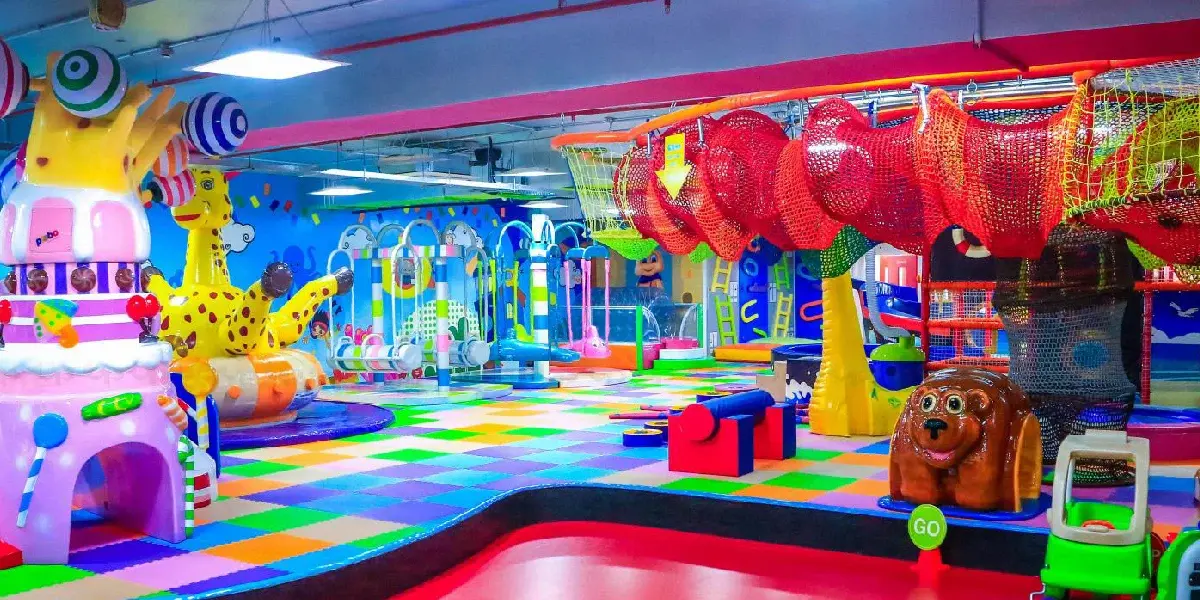
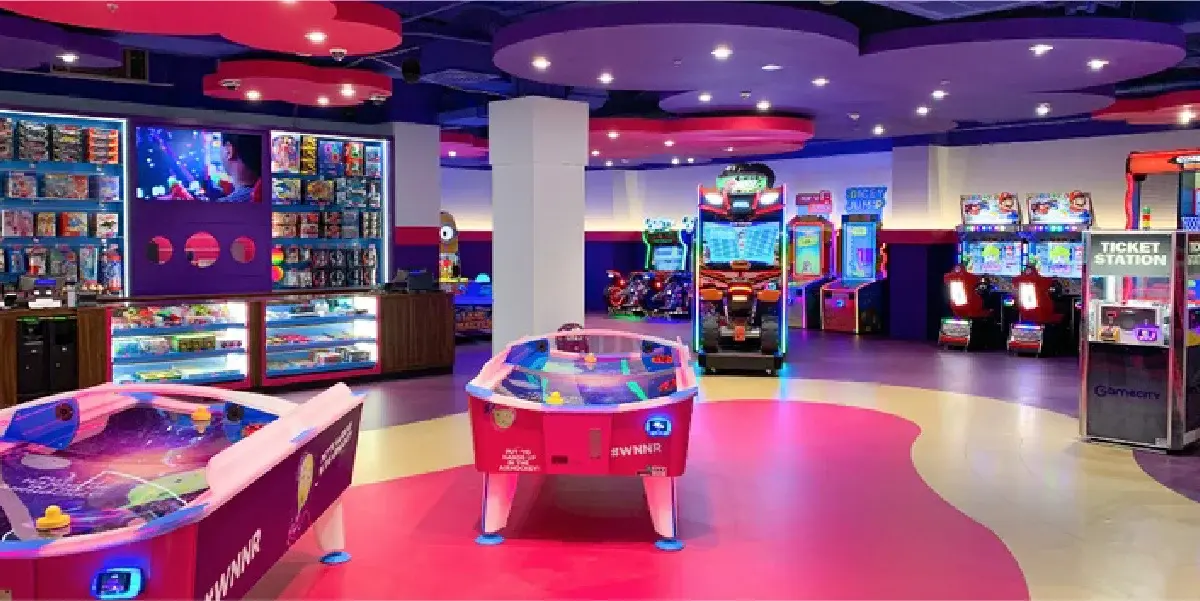
The FEC’s theme should cater to the ‘why’ of the business, its estimated foot traffic, target audience, location, and activities and attractions offered. FACE Amusement started as a single claw machine in 1978. Over time, it has expanded into a multi-location FEC with unique offerings and entertainment concepts, including the famous Downtown Flavortown, an F&B concept with celebrity chef Guy Fieri.
When doing this, it is smart to work with professional design firms in the amusement industry to stay consistent with your FEC’s theme. Here are 5 Family Entertainment Center Interiors Inspirations to get your creative juices flowing.
Apart from the theme and design, this is also the point where the floor plan and construction blueprint are finalised.
In IAAPA’s 2025 Entertainment Center Benchmark Report, arcades (redemption and non-redemption) are the most common attractions for FECs and are mostly managed in-house. At the same time, arcades and video games account for more than one-third of the front-of-house footage of the floor plan.
The statistics also show that arcades represent the top revenue sources for FECs. This data is essential to conceptualising and designing your business.
Get Licenses & Permits
Choose The Right Technology
The FEC industry has been heavily impacted by advances in technology in a span of years. Advancements in home video game console technology in the 80s caused a great decline in the ‘Golden Age of Arcades,’ resulting to a huge gap in revenue from $8B in 1981 to $2.1B in 1991.
Since then, almost every touchpoint of the business has been automated. Those that fail to jump on the wagon and follow tech trends cease to continue because they have become irrelevant. However, arcades can now be supercharged with hardware solutions that bring even retro games to the digital age.
Technology is considered a business essential in this digital day and age. Consumers will not tolerate a poor guest experience due to a low-tech business. This is why you need to stay up to date if you want consumers to come over; otherwise, it will lead to poor customer reviews and negative advocacy.
Websites account for 23% of overall ticket sales, according to IAAPA’s 2025 Benchmark Series. Tech-driven ticket distribution channels like this can be adopted early in your operational year to leverage guest preference for cashless means to pay and play.
When used strategically, business operations and management can be conveniently integrated in a way that reduces operating, labour, and maintenance costs. Most of all, the guest experience is enhanced.
Selecting the right hardware and software for your FEC is just as important as picking the best people for the business. With the right combination of hardware and software, these technological business solutions can already stand as your 24/7 employees.
FEC software should collect data, pinpoint problems, and generate results and notifications in real-time to reduce costs while increasing profitability. In short, the software should simplify the backend of the business. At the same time, it should be backed up with a reliable tech provider, or solutions powered by the world’s best tech partners like Amazon Web Services, Google, or Apple.
From a customer standpoint, consumers desire seamless, personalised, socially shareable, and convenient tools that keep them immersed in the experience with little to no disruptions. The speed and immediacy of the experience are critical to your success. In the fast-paced world today, guests are intolerant of wasting time waiting in long lines and outdated or no technology to ease transactions that should be seamless.
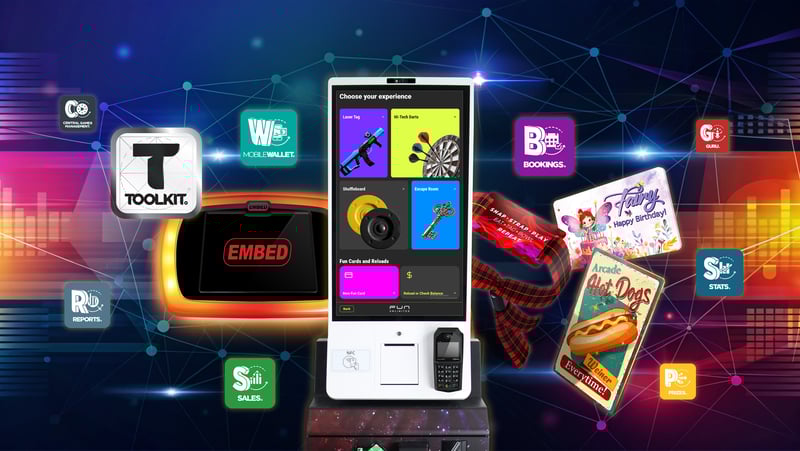
Depending on the nature of your FEC business, here are some of the hardware and software solutions worth your consideration:
Hire Your First Team
Start Branding & Marketing the Business
FEC Grand Opening Checklist
-
- Operations plan - Based on anticipated foot traffic, create a manpower strategy for maximum efficiency, with the following key points as your guide:
- Demand, capacity, and pricing design – Before building or leasing a place, model peak-hour demand, anticipated queue length, and game floor or party room utilisation.
-
- Product and price architecture – This includes admission, timed play, bundles, memberships, events, and group sales, along with your determined targets to each like hourly throughput per attraction, utilisation percentage, average minute in queue, turnouts, demand forecast, staffing curves, floor layout, and dynamic pricing rules for both peak and off-peak hours.
-
- Labour model – Assign staffing per post and dedicated schedule and rotation for regular training, reporting, and meetings.
-
- Safety and compliance – This should have all SOPs for attractions, inspections, F&B handling, guest safety, and accessibility, including insurance certifications, safety permits, evacuation plans, and drills. Likewise, it should cover your preventive maintenance calendar for games, attractions, kitchen, inventory, and vendors.
-
- Revenue control – This is where you can map different revenue streams and assign their respective owners and KPIs. Create your targets and the corresponding implementations and tools to achieve them like going cashless, loyalty programmes, and comp controls.
-
- Daily rhythm – Outline different controls and tools staff and management will access every operational day, like POS integrations, game and reader access, CRM, reporting tools, and dashboards.
- Marketing plan - This includes game promos, free memberships, loyalty programmes, exclusive merch, promotional materials and announcements, and other freebies. Get online and stay online as a tactic to keep your brand on top-of-mind. Craft easy, straightforward campaigns to engage active participation of your target audience and reward them with something so good, they’ll be enticed to go to your venue.
- Food & beverage - Some sample food & beverage offerings you can do as opening promos are free dinner for every game pass, free round of drinks with an order of any 2 appetizers, or free salad bar with dinner. Get creative with your offering but remember that the mechanics should be easy enough to get consumers to visit your venue and spend.
- Thematic décor and setup - To complete the package, dress up your venue to impress. Stage the experience in a way that is seamless, consistent, and excellent. The first look is always crucial – how you make guests feel in that first encounter will affect their decision; will this be a one-time visit or will this be their go-to?
Download the full FEC Grand Opening Checklist here.
- Operations plan - Based on anticipated foot traffic, create a manpower strategy for maximum efficiency, with the following key points as your guide:
Adopt Family Entertainment Center Software for Business Management
“Go for an integrated ecosystem instead of siloed apps and software stitched together. ”
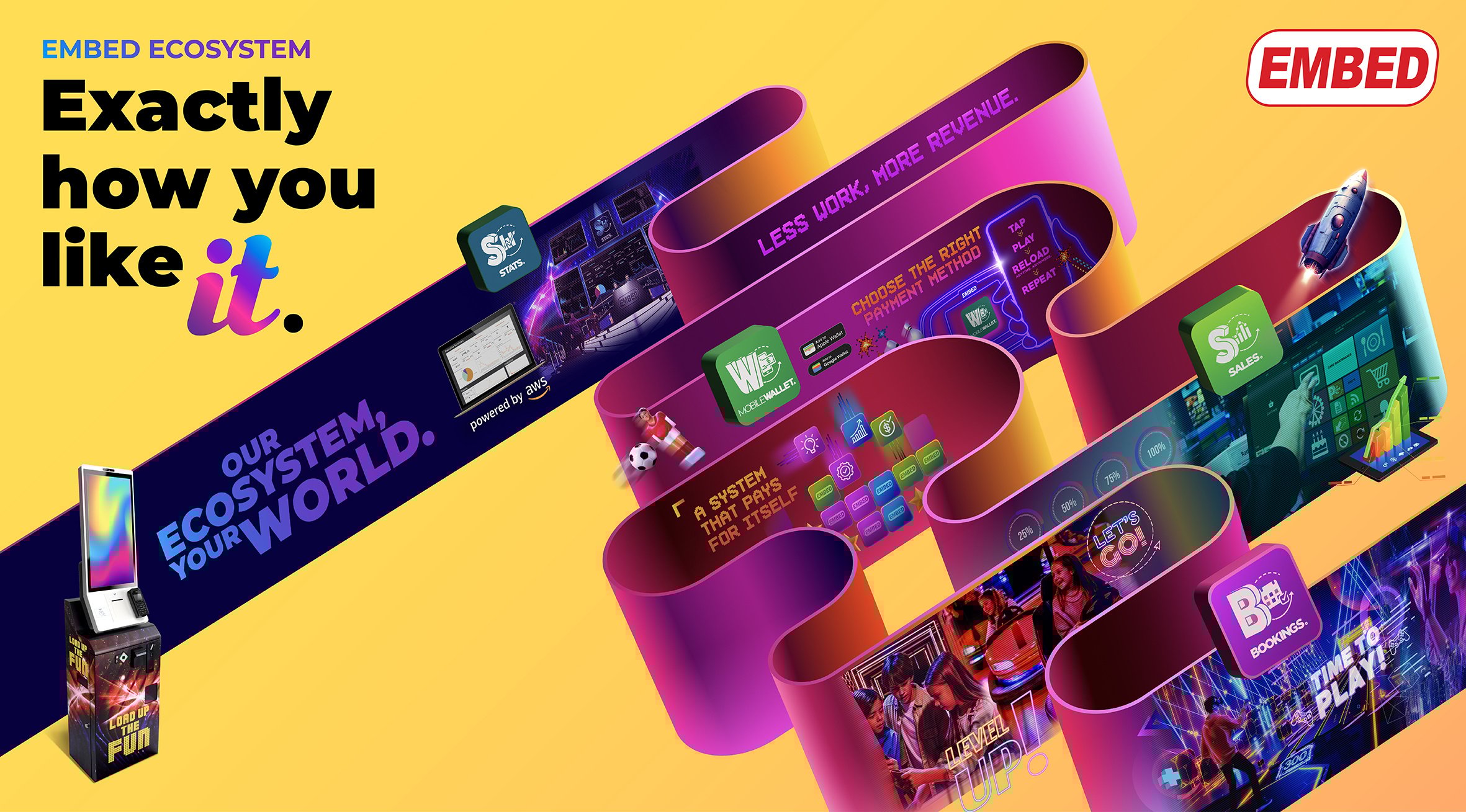
From front-of-house to back-office, run your workflows from one source of truth for a more streamlined management. This means:
- Fewer spreadsheets and reconciliations – Less paperwork and manual data and reports alignment = less manhours dedicated to tasks that can otherwise be automated.
- You can have it all without needing to plug it all – Since a centralised FEC management software or ecosystem is in play, you can lessen hardware footprint on your game floor and eliminate unnecessary software subscription costs for multiple platforms.
- Connecting to the cloud to sync it all – When cloud-based systems free up your onsite servers, you have more bandwidth to operate and accept payments even during downtimes or outages. Plus, you have visibility and access over your FEC data and reports from anywhere, even across multiple locations as you scale the business.
How do FEC management systems benefit you as an operator?
- High revenue per guest/visit
With an automated system, you can have higher FEC profitability through designing pre-arrival upsells, bundles, packages, and other FEC revenue models from your reports insights and guest database from your unified ecosystem. - Lower operational costs
All your data and management in one place streamlines your operations, boosting manpower and eliminating admin costs with reduced manual tasks and error reconciliation. - Data-driven decision-making
You have the numbers and insights to avoid guesswork—monitor games performance, peak hours, guest activity and spending on a regular basis to better understand the business. - Superior guest experience
You can focus more on improving the guest experience with every visit thanks to family entertainment center software that frees up you and your manpower of manual tasks.
How should you choose the best FEC software for you?
Check on the following capabilities and features when considering the FEC management system that suits your business:
- APIs, integrations, and ecosystems – Be on the lookout for API customisability, deep integrations with your range of games and operational software, and technical capacity for expansion as your business grows.
- Reliability and support – Ensure that your solutions providers are backed and powered by reliable tech providers to ensure minimal downtime and issues especially during peak times. Double-check support team’s availability, channels, implementation timelines, regular training schedule, and after-sales care.
- Hardware compatibility – Based on the games and attractions you will offer, go for solutions that will work best together, like a compatible system of kiosks, scanners, tablets, prize hubs, and card readers.
- Cost of ownership and maintenance – Keep in mind the cost of licensing, payment rates, installation, support, updates, hardware, maintenance, and other factors that will affect your operational costs. The real win is scoring a system that pays for itself over time.
Overwhelmed with your choices?
Our Embed Mavericks can walk you through these and go through technical and operational aspects step-by-step to help you arrive at the right decision.







.svg)
.svg)
.svg)
.svg)
.svg)